


European Legislation Journal Archive
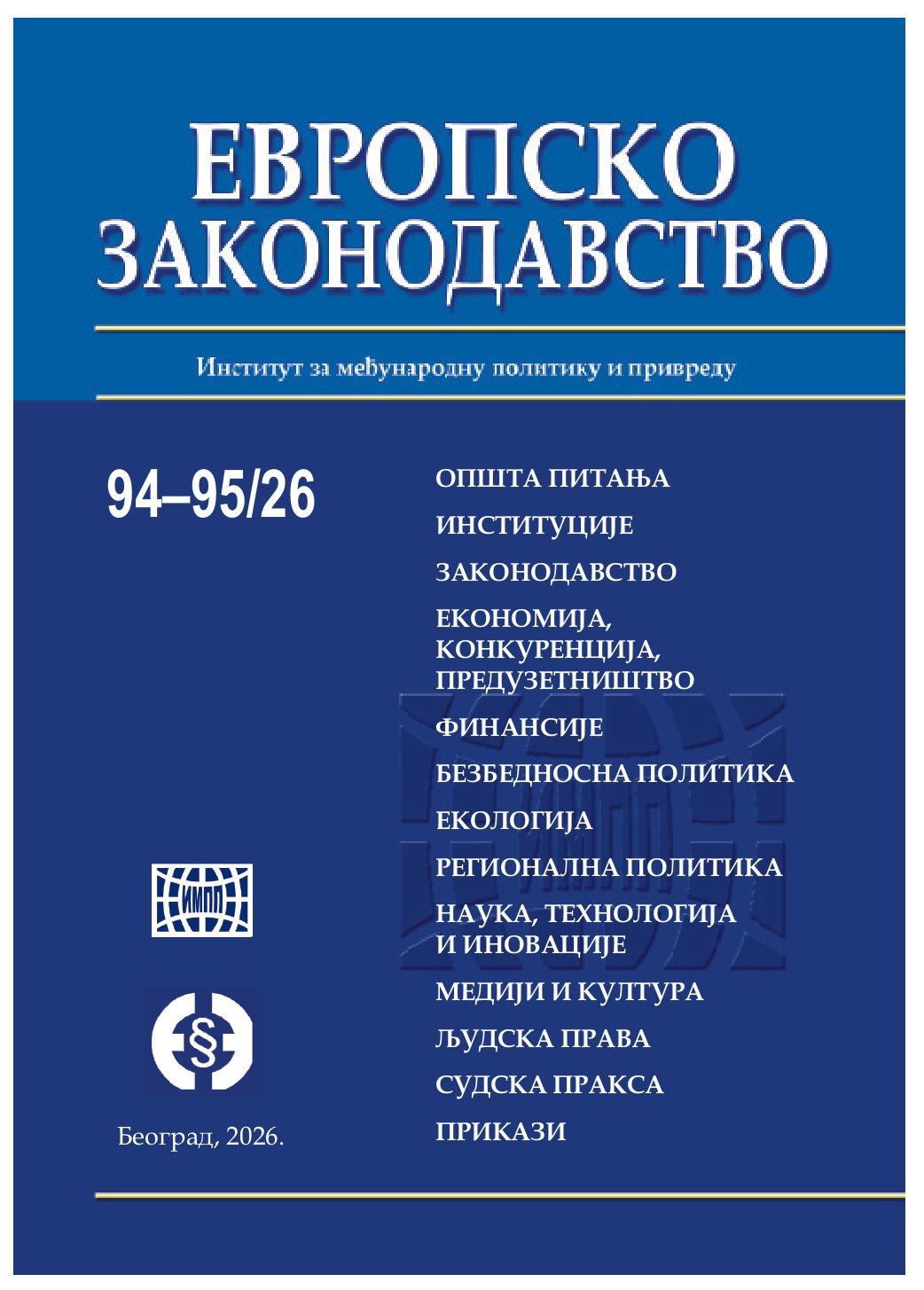
European Legislation Vol. 25 No. 94-95/2026
OPŠTA PITANJA

European Legislation, 2026 25(94-95):11-19
 267.02 KB)
Abstract ▼
The Trump administration has freed international relations from formal obligations to respect international law and the principle of interdependence among states. In such a new world of interest‐driven realism, the European Union must shed legal idealism and naivety and project its power. Europe needs stronger internal economic cohesion, a more efficient decision‐ making model, and the preservation of the independence and culture of European peoples. Protection from migration from the African continent, whose population is growing rapidly, implies raising the birth rate. European independence, on the other hand, presupposes investment in new technologies and the development of its armaments industry. The Union thus faces several unresolved issues in completing its integration and achieving strategic stability and autonomy. The admission of the Western Balkans countries into the European Union has great economic, political, and security significance. However, due to the absence of constitutional reform, the European Union has not been able to complete this task. Today, various options are emerging regarding the admission of new member states, such as membership without the right of veto.
European Legislation, 2026 25(94-95):21-47
Abstract ▼
Trade conflicts with the United States (US) and China have accelerated the need for greater self‐sufficiency in key sectors of the European Union (EU). The new Industrial Acceleration Act, adopted by the European Commission in March 2026, will determine whether the “Made in EU” industrial policy can facilitate cooperation with trading partners while avoiding protectionist traps, particularly in relations with China. The aim is to support production in the EU. Partners covered by free trade agreements, as well as signatories of the WTO General Agreement on Government Procurement, would be allowed to participate in EU member states’ public procurement. Reducing risky dependence on Washington is closely linked to efforts to open new market access opportunities for the EU. While there are more than 40 EU trade agreements with partners, many others are in the pipeline, with the two most important ones—with the Southern Common Market in Latin America (MERCOSUR) and India—having been signed in January this year. These agreements send a strong geopolitical signal that the participating countries want to trade and cooperate under predictable and rules‐based conditions. The EU and its economic partners have an opportunity to lead the world towards a new multilateralism. Ideally, countries should devise new rules on subsidies and economic security while deepening cooperation on rare earth elements and critical raw materials within the framework of the World Trade Organisation (WTO) or based on plurilateral arrangements, thereby increasing resilience in global supply chains. To remain a reliable partner, the EU must remain open. The new industrial policy aimed at strengthening the competitiveness of European industry, accelerating the green transition, and facilitating foreign investment should be more flexible with regard to numerous administrative requirements and the desire for full reciprocity in public procurement.
INSTITUCIJE
European Legislation, 2026 25(94-95):49-70
Abstract ▼
The digital transformation of judicial institutions represents one of the most significant processes in the contemporary development of the European legal area, given that the application of information and communication technologies substantially affects the efficiency, transparency, and accessibility of justice. This paper analyses the European standards for digital communication in the judiciary, with particular emphasis on the development of e‑justice systems within the member states of the European Union and on the degree of harmonisation of the judicial system of Bosnia and Herzegovina with contemporary European trends in judicial digitalisation. Special attention is devoted to the normative and institutional framework of the European Union, standards for electronic data exchange, personal data protection, and cybersecurity issues in digital justice. The paper points out that the digitalisation of judicial institutions no longer represents a matter of technical modernisation exclusively, but rather constitutes one of the key prerequisites for efficient international judicial cooperation and the functioning of the modern concept of the rule of law. The analysis demonstrates that a certain level of progress has been achieved in Bosnia and Herzegovina in the field of e‑ justice. Further normative, institutional, and technical reforms remain necessary to achieve full compliance with European standards.
ZAKONODAVSTVO
European Legislation, 2026 25(94-95):71-93
Abstract ▼
ESG criteria (Environmental, Social, and Governance) are important instruments of sustainable, transparent, and responsible business practices in modern legal and economic systems. In European Union (EU) law, ESG standards have developed within a comprehensive normative framework that includes non‐financial reporting, climate policy, and sustainable financing. Of particular importance are the regulations governing obligations to disclose information on environmental, social, and corporate governance impacts, as well as mechanisms for encouraging green investments. The paper analyses the ESG criteria in EU law and the challenges of harmonising the Republic of Serbia’s legislation with the EU acquis. The paper points to the need for further harmonisation of the domestic legal framework, especially in transparency and accountability of economic entities, as well as the practical challenges associated with implementing the regulations, including limited institutional capacities and the need to strengthen supervision. ESG regulations are important factors in the European integration process and in improving the competitiveness of the Republic of Serbia’s economy.
European Legislation, 2026 25(94-95):94-119
Abstract ▼
In the era of the fourth industrial revolution, personal data has become the most valuable resource of the digital economy, yet also the most vulnerable point for individual privacy. Mass collection, algorithmic processing, and global information flows have necessitated a robust and uniform legal framework to address challenges unforeseen by traditional law. This paper analyses the degree of compliance and key normative parallels between the legal frameworks for personal data protection in the European Union and the Republic of Serbia. The central subject of the research is the relationship between the General Data Protection Regulation (GDPR) and the domestic Law on Personal Data Protection (LPDP) of 2018. The author proceeds from the thesis that the Republic of Serbia, within the European integration process, has carried out extensive harmonisation of its regulations, adopting the basic concepts, processing principles, and data subject rights from the European model. The first part of the paper examines the evolutionary processes that led to the adoption of current regulations. The central part provides a comparative analysis of institutes, such as processing principles, legal bases, and the role of supervisory authorities. Special emphasis is placed on the institutional framework, comparing the powers of the Commissioner for Information of Public Importance and Personal Data Protection in the Republic of Serbia with those of supervisory authorities in EU member states, while noting significant differences in penal policy and enforcement mechanisms. The final segment of the paper is dedicated to the challenges of cross‐border data transfer and Serbia’s prospects for obtaining an Adequacy Decision from the European Commission. Concluding remarks indicate that, despite a high rate of normative alignment, practical application and ensuring the full effectiveness of rights in the Republic of Serbia still face challenges due to specific socio‐legal circumstances and administrative capacities.
European Legislation, 2026 25(94-95):120-140
Abstract ▼
This paper presents the main elements of the Regulation establishing an Entry/Exit System (EES) for the registration of entry and exit data and data relating to refusals of entry concerning third‐country nationals crossing the external borders of the Member States of the European Union (EU) as well as for determining the conditions for access to the EES for law enforcement purposes. The Regulation in question aims to regulate the conditions governing the entry and exit of third‐country nationals into and from the Member States of the EU. It establishes an electronic system to record and verify the entry and exit of third‐country nationals at the Union’s external borders. The new rules are intended to ensure the protection of public policy, internal security, and public health within the Member States of the EU.
EKONOMIJA, KONKURENCIJA, PREDUZETNIŠTVO
European Legislation, 2026 25(94-95):141-160
Abstract ▼
European Union (EU) standards and regulations are the foundation of a successful hotel and restaurant business. Properly defined regulations ensure cost control, while standards guarantee uniform quality of service. EU hotel and restaurant standards are a key mechanism for ensuring high‐quality service, food safety, and consumer protection. Through strict regulations, categorisations and certifications, the EU guarantees a uniform customer experience and sustainable business across its market. To become compliant with EU standards in the hotel and restaurant industry, Serbia needs to transpose EU regulations and ensure their full implementation. This implies that the competent authorities carry out inspection and supervision, as well as that the necessary laboratories are in place. It is also necessary to ensure that food business operators (i.e., everyone who produces, processes, or distributes food or is otherwise involved in the chain) are well‐trained and aware of their responsibilities. Standards in the hotel and restaurant industry in the EU are not defined by a single universal law. They are a combination of binding regulations (e.g., food safety), voluntary standards (ISO), and industry classifications (star ratings for hotels). Hospitality establishments (hotels and restaurants) that apply professional standards achieve stable, profitable, and long‐term business.
FINANSIJE
European Legislation, 2026 25(94-95):161-171
Abstract ▼
Ukraine has suffered significant material destruction since the start of the conflict with Russia in 2022 and therefore requires significant material resources to maintain its macro‐financial stability. Ensuring Ukraine’s macro‐ financial stability is extremely important for its post‐war reconstruction, which is why the European Parliament and the Council adopted Regulation 2024/2773 on Establishing a Loan Cooperation Mechanism and providing exceptional macro‐financial assistance on October 24, 2024. Through this mechanism, the European Union (EU) should allocate appropriate financial resources to Ukraine. In addition to EU Member States, third countries could also participate in financing Ukraine’s post‐war reconstruction. However, the granting of loans and credits implies the fulfilment of certain conditions controlled by the European Commission. Failure to meet them could lead to the suspension of funding. Some of these conditions also concern the end of the military conflict with Russia.
BEZBEDNOSNA POLITIKA
European Legislation, 2026 25(94-95):173-196
Abstract ▼
Since its establishment, the European Union (EU) has gone through several stages of development. Significantly, this international organisation has grown into a supranational community of states that share similar views on international politics and security. The process of creating the EU Common Foreign and Security Policy (CFSP) and the Common Security and Defence Policy (CSDP) within it began with the Maastricht Treaty. It continues through the treaties on the functioning of the EU. Finally, the process was completed with the adoption of the Global Strategy for Foreign and Security Policy in 2016. The EU’s Common Security and Defence Policy had military and civilian components. In 2003, the first EU civilian and military missions were sent to third countries. In addition, cooperation with third countries was carried out through their participation in civilian and military missions. Based on the Council conclusions of November 19, 2018, the strengthening of the civilian segment of the CSDP began. The paper analyses the legal position and significance of EU civilian missions. The analysis includes a study of the solutions adopted in primary and secondary legislation, as well as a discussion of existing EU missions. The conclusion is that civilian missions are a useful tool for cooperation between the EU and neighbouring countries as well as for strengthening the EU’s presence in the international environment. Given that missions are established at the request of the host country, the status of personnel is regulated by the relevant agreements (SOMA). The inclusion of the Republic of Serbia’s civilian representatives in EU missions would contribute not only to the fulfilment of its pre‐accession obligations under Chapter 31 but also to the professionalisation of its staff. The paper uses historical and comparative methods, as well as the content analysis of legal acts.
European Legislation, 2026 25(94-95):197-217
Abstract ▼
Our paper examines the geopolitical context of the Visegrad Group’s functioning. The Visegrad Group is an alliance of four Central European countries: the Czech Republic, Hungary, Poland, and Slovakia. Since its establishment in 1991, this group has been working to strengthen cooperation, European integration, and harmonisation of political interests within the European Union (EU). Energy security is of particular importance within the framework of cooperation, which in the current crisis environment is conditioned by antagonisms between the EU and the Russian Federation. The paper analyses the Green Transition platform, which, in addition to technical propositions, also includes a broadly conceptualised social process. Using a multidisciplinary approach, the author seeks to clarify the dependence of microregions on Russian energy sources, the structure of energy capacities, infrastructure projects, and diversification, as well as social risks and implications for the energy transition process. The current topic also deals with the analysis of political, social, and economic challenges, climate policies, and financial programmes to support their implementation. The goal of the analysis is a holistic view of the positions of the Visegrad Group (V4) countries with regard to the indigenous paradigm of geostrategic interests and long‐term energy security. Through the comparative scientific method, the author seeks to synthesise knowledge in this area to point out its importance for the Western Balkans and especially for the Republic of Serbia. The paper points out the internal contradictions in the Visegrad Four countries, which are particularly expressed in the current geopolitical circumstances that prevent the realisation of an inclusive energy perspective.
European Legislation, 2026 25(94-95):218-241
Abstract ▼
The paper analyses the reorientation of the European Peace Facility towards Ukraine and its significance for the Republic of Serbia in the context of the changing European security environment and the increasingly pronounced geopoliticisation of the European Union’s actions. Starting from the fact that the European Peace Facility was established as an extra‐budgetary mechanism of the Common Foreign and Security Policy (CFSP) for financing activities with military and defence implications, the paper examines how this instrument, through Council decisions and subsequent accompanying acts, gradually became one of the main mechanisms for military and broader financial support for Ukraine. The analysis revealed that the initial general framework of the instrument, established by Council Decision (CFSP) 2021/509, is already being specified in 2022 through an auxiliary measure for the supply of military equipment and platforms intended for the use of armed (lethal) force to the Armed Forces of Ukraine, while subsequent amendments increase its financial scope and expand the content of the support. Of particular importance is Council Decision (CFSP) 2024/890, which amends the basic act itself and introduces a specific earmarked amount for Ukraine, whereby support for Ukraine no longer appears only as an individual measure but as part of a broader financial and institutional reshaping of the instrument. The paper concludes that this change is also significant for Serbia, as it indicates a strong connection between European integration and foreign policy and security coordination, especially in relation to Ukraine, Russia, and the new EU defence agenda.
European Legislation, 2026 25(94-95):242-257
Abstract ▼
Corporate security implies an appropriate traditional social approach to the protection of European corporations, achieved by securing property, capital, and their creators. Security presupposes preventive measures against all forms of destructive threats in the field of business. In modern European business conditions, corporate security has developed into an independent business function on equal footing with other functions. Today’s business of European corporations carries a certain level of risk. Adequate risk assessment and engagement in ruthless market competition are measured by quantities such as profit. For this reason, the role of corporate security and risk assessment, with appropriate managerial knowledge, is the foundation of a successful business venture. The forms of security threats may be different. However, the specifics of the above‐mentioned issues are “more or less” identical in all EU countries, including the Western Balkans countries. The basic problem of protecting a company is that the forms of threats are constantly changing and transforming into other forms of threats until an effective way of combating them is found. All this requires a high level of material expenditure and, in particular, a great ability to understand these phenomena. Crisis management plays a major role in such activities, which, according to European standards, must predict, react, and regulate existing business problems.
EKOLOGIJA
European Legislation, 2026 25(94-95):259-278
Abstract ▼
Environmental degradation is one of the most complex challenges facing the international community today. The core of the problem lies in the tension between the states’ interests in exercising sovereign rights and the interests of environmental protection. The principle of the no‐harm rule in international environmental law operates as a technique for resolving these complex problems with consideration and by balancing interests. The obligation not to cause harm is an indispensable part of this principle and an operational mechanism that sets the standards of conduct required of states. This approach implies that the focus is not on the protection of ecological integrity itself but on the threshold of harm and due care, i.e., standards that are generally insufficiently legally specified. However, the urgency to protect the environment from degradation reflects an important trend of giving greater and more privileged importance to the protection of ecological values related to state‐centric interests.
REGIONALNA POLITIKA
European Legislation, 2026 25(94-95):279-299
Abstract ▼
The paper analyses reasons why the European Grouping of Territorial Cooperation (EGTC), regulated by Regulation (EC) No. 1082/2006 and then updated by Regulation (EU) No. 1302/2013, has not become an operational instrument of integrated territorial governance in the Republic of Serbia. The fact is that Serbia already has a general legal framework for cooperation between local governments and partners from other countries; the basis at the internal legal level is found in the provisions of Articles 13 and 88b of the Law on Local Self‐Government, while at the international legal level, it is found in the provisions of Protocol No. 3 to the European Framework Convention on Transfrontier Cooperation, which Serbia ratified in 2018. Serbia signed the European Framework Convention on Cross‐border Cooperation between Territorial Communities or Authorities on May 29, 2015, and ratified it in 2016. In the Declaration made with the ratification, it is stipulated that the application of the Convention depends on the prior conclusion of interstate agreements or, in their absence, on the express consent of the governments of the countries concerned, which directly affects the activities of local self‐government units whose cross‐border activities remain subject to the approval of the national level of government. The Action Plan for Chapter 22, in measure 1.12, indicates that Serbia still lacks the basis for the application of the EGTC Regulation, including the authorities responsible for its application, approval, registration, and publication, as well as further alignment with the rules relating to public funds, public procurement, VAT, and customs. Finally, the analysis concludes that the establishment of an operational domestic EGTC system would enable Serbia to move from an ad hoc, project‐based approach to an institutional logic of crossborder cooperation, especially in the areas of public services, transport, tourism, education and territorial planning.
NAUKA, TEHNOLOGIJA I INOVACIJE
European Legislation, 2026 25(94-95):301-340
Abstract ▼
Since the end of the nineties of the 20th century, the European Union (EU) has been developing its own space initiatives and programmes, such as the European Geostationary Navigation System (EGNOS), Galileo, and Copernicus, which aim to respond to the needs of European citizens and the demands of EU public policies. To ensure their continuity and improve the existing space capacities in the field of providing space services and the transformation and development of digital and information and communication technologies, as well as to enable the fulfilment of priorities in the areas of climate change, transport, security, and defence, on April 28, 2021, the EU adopted Regulation 2021/696 establishing the European Space Programme. The Regulation establishes the Programme’s objectives, the budget, and forms of financing for the period from 2021 to 2027. At the same time, the Regulation establishes the EU Agency for the Space Programme (EUSPA), which replaces the European Agency for Global Satellite Navigation Systems (GNSS) established by Regulation 912/2010 of September 22, 2010. In the work that follows, the adopted legal solutions related to the Space Programme are considered, as well as the powers of the EU agency responsible for its implementation.
European Legislation, 2026 25(94-95):341-361
Abstract ▼
This paper examines the United Kingdom’s AI Security Institute and the European Union’s AI Office as two prominent institutional responses to the challenges posed by the development and deployment of artificial intelligence. Building on an analysis of their mandates, organisational structures, and operational instruments, the paper explores how these two institutions shape the understanding of risks, public policy priorities, and practical mechanisms for overseeing advanced AI systems and models. A comparative approach shows that the UK AI Security Institute operates primarily as an operational body focused on technical evaluation and testing in close cooperation with the industry. On the other hand, the EU AI Office plays a central role in implementing the regulatory framework and ensuring compliance with established rules. Particular attention is given to the implications of these differences for risk governance, innovation, and the protection of societal values. The analysis of these institutions contributes to a broader understanding of contemporary models of AI governance, which are still in the early stages of development. The paper concludes that effective AI governance requires a combination of technical expertise and regulatory structuring, thereby opening space for further institutional convergence and enhanced international cooperation.
MEDIJI I KULTURA
European Legislation, 2026 25(94-95):363-375
Abstract ▼
The development of generative artificial intelligence represents one of the most significant transformations of the contemporary media ecosystem, particularly in the field of media content distribution. While traditional distribution models were based on editorial selection and institutionally controlled channels of information dissemination, digital platforms, search engines, and algorithmic systems increasingly assume the role of key intermediaries in the public information process. In this context, generative artificial intelligence no longer functions solely as a technological tool for automation but also as an active actor in the generation, filtering, personalisation, and distribution of media content. This paper analyses the impact of the European regulatory framework on the management of media content distribution in the context of the development of generative artificial intelligence. Particular attention is devoted to the Digital Services Act (DSA), the European Media Freedom Act (EMFA), and the Artificial Intelligence Act (AI Act) as key regulatory instruments governing digital services, media freedom, and algorithmic systems within the European Union. The paper examines issues related to algorithmic transparency, systemic risks, editorial independence, and the labelling of AI generated content. The analysis demonstrates that generative artificial intelligence transforms media content distribution into a complex technological and regulatory system, thereby imposing new obligations on media management in the areas of algorithmic governance, ethical standards, and the protection of the public interest. At the same time, the European regulatory framework seeks to establish a balance between technological innovation and the preservation of democratic values within the digital public sphere.
European Legislation, 2026 25(94-95):376-391
Abstract ▼
The paper analyses the impact of the European Union’s legal acquis communautaire on the legal status and protection of Serbian historical heritage in the territory of present‐day Serbia and North Macedonia. The paper also reviews cultural heritage in the pre‐Yugoslav historical period. Starting from the international legal framework of public property, the paper examines the extent to which European law influences the resolution of issues that formally remain within the exclusive jurisdiction of states. The central hypothesis of the paper is based on the view that the European Union does not directly regulate issues of public property and historical and cultural heritage, but, through the principles of legal certainty, property protection, and good neighbourly relations, it shapes the legal and negotiating international framework in which these issues are resolved. The paper shows the European Union has limited legal capacity to protect the cultural and historical heritage of states located in third countries. In the context of Serbia’s European integration, the issue refers to its cultural and historical heritage located in the territories of the successor states of the former SFR Yugoslavia, whose internal legislation is “more or less” in line with European and international standards. To govern all open issues related to this heritage consistently and legally, neighbouring states should regulate these issues through diplomatic channels and the conclusion of bilateral agreements. As an illustration, consider North Macedonia, whose territory contains several significant Serbian historical and cultural sites for which appropriate legal remedies should be devised.
LJUDSKA PRAVA
European Legislation, 2026 25(94-95):393-413
Abstract ▼
The article analyses the EU Action Plan on Human Rights and Democracy (2020–2027) in the context of the evolution of the European Union (EU) as a normative force in international relations. It starts from the thesis that the EU has transformed its foreign policy over time from a predominantly economically oriented project to a values‐based actor in which human rights occupy a central place. Particular attention is paid to the normative and institutional framework of the Action Plan and its key objectives and new priorities, including digital rights, climate change, and strengthening democratic resilience. The paper suggests that the Action Plan represents a significant attempt to integrate human rights into all segments of the EU’s external action but also that its soft‐law legal nature and complex institutional structure limit its effectiveness. In particular, it highlights the gap between normative ambitions and practical implementation, which stems from political differences among member states and competing geopolitical interests. It concludes that the Action Plan strengthens the EU’s normative framework but that its transformative potential depends on consistent implementation and institutional coherence.
European Legislation, 2026 25(94-95):414-441
Abstract ▼
Article 41(3) of the Charter of Fundamental Rights of the European Union (EU) guarantees the right to compensation for damage caused by EU institutions or servants in the performance of their duties, in accordance with the general principles common to the laws of the Member States. On the other hand, the question arises as to how effective this guaranteed right is in practice. Since the entry into force of the Lisbon Treaty, which made the Charter of Fundamental Rights legally binding, the General Court and the Court of Justice of the EU have continued to apply strict liability criteria, and claims for compensation for damage have rarely been successful before the courts. This paper critically assesses the effectiveness of Article 41(3) of the Charter of Fundamental Rights, which, despite being framed as a “fundamental right”, has had limited impact due to the entrenched doctrine of restrictive liability, according to which the EU courts prioritise institutional discretion over individual rights to compensation for damage. The result is a persistent gap between the symbolic value of Article 41(3) of the Charter of Fundamental Rights and its effectiveness. Nevertheless, some progress has been made in several recent cases before the General Court, which will be discussed in this article.
European Legislation, 2026 25(94-95):442-466
Abstract ▼
The topic of the position of women and gender (in)equality represents an essential challenge for all relevant practitioners from ancient times and the protests of Roman women to the present day. The above phenomena have triggered numerous controversies with explicit connotations in the theory and practice of individual states. Our work considers influential postulates on this issue in democratic and totalitarian societies, starting from feminism and the axiom that the position of women depends primarily on the conglomeration of political and social freedoms and not exclusively on formal legislative regulation. By analysing and synthesising the current topic in the Republic of France, the Russian Federation, and Saudi Arabia, we will point out the specificities of gender equality in democratic and totalitarian social structures. Cognitive research implies that authoritarian regimes limit the emancipatory potential of equality, reducing it to a symbolic, i.e., controlled, pragmatic reality. It can be objectively stated that women’s equality in Western democratic societies (in France) is insufficiently aligned with existing legal regulations, which is why the EU represents an important catalyst for the real, and not just formal, achievement of gender equality. On the other hand, in orthodox regimes (Russia and Saudi Arabia), women’s equality has retrograde connotations, so some modernisation is needed in terms of human rights protection but also the consistent application of international legal standards.
SUDSKA PRAKSA
European Legislation, 2026 25(94-95):467-502
Abstract ▼
This paper analyses the role and scope of the national identity clause enshrined in Article 4(2) of the Treaty on European Union within the contemporary legal order of the European Union, with particular emphasis on the latest developments in the case law of the Court of Justice of the European Union. Starting from the premise that national identity does not operate as an absolute limit to the application of European Union law but rather as a legally relevant argument that must form part of a functional judicial dialogue, the paper examines the relationship between the autonomy of the legal orders of the Member States and the requirements stemming from European Union law, particularly in the context of free movement, EU citizenship, and the protection of fundamental rights guaranteed by the Charter of Fundamental Rights of the European Union. The first part of the paper analyses the position of the national identity clause and its normative evolution, as well as the principal doctrinal understandings of national identity as a constitutive element of the European legal order. Particular attention is devoted to the preliminary ruling procedure and the shaping of constitutional dialogue between national legal orders and the legal order of the European Union. The central part of the analysis focuses on the case law of the Court of Justice of the European Union concerning the crossborder recognition of personal and family status, particularly in cases arising from preliminary references submitted by courts in Eastern Europe. This contribution demonstrates that, in its more recent jurisprudence, the Court of Justice increasingly prioritises the effective enjoyment of rights deriving from Union citizenship and the rights guaranteed by the Charter. The national identity argument retains only a limited autonomous scope. At the same time, it is argued that, although the Court formally recognises the importance of Article 4(2) TEU, it has not developed a sufficiently clear methodology for balancing the protection of national identity against the requirements stemming from European Union law. The conclusion argues that the future development of the relationship between national identity and European Union law will largely depend on the further evolution of cooperative judicial dialogue between national courts and the Court of Justice of the European Union. The paper advances the view that Article 4(2) TEU should not be perceived as a “shield” against European Union law but rather as a mechanism of cooperative constitutional dialogue capable of preserving the cohesion of the European legal space while respecting the constitutional specificities of the Member States.
PRIKAZI
EU Foreign and Security Policy in Contemporary International Relations: Selected Case Studies
European Legislation, 2026 25(94-95):503-506
Space Geopolitics and International Law
European Legislation, 2026 25(94-95):507-514
Financial Disruptions in the Era of Post-Pandemic Geopolitical Divides
European Legislation, 2026 25(94-95):515-518